
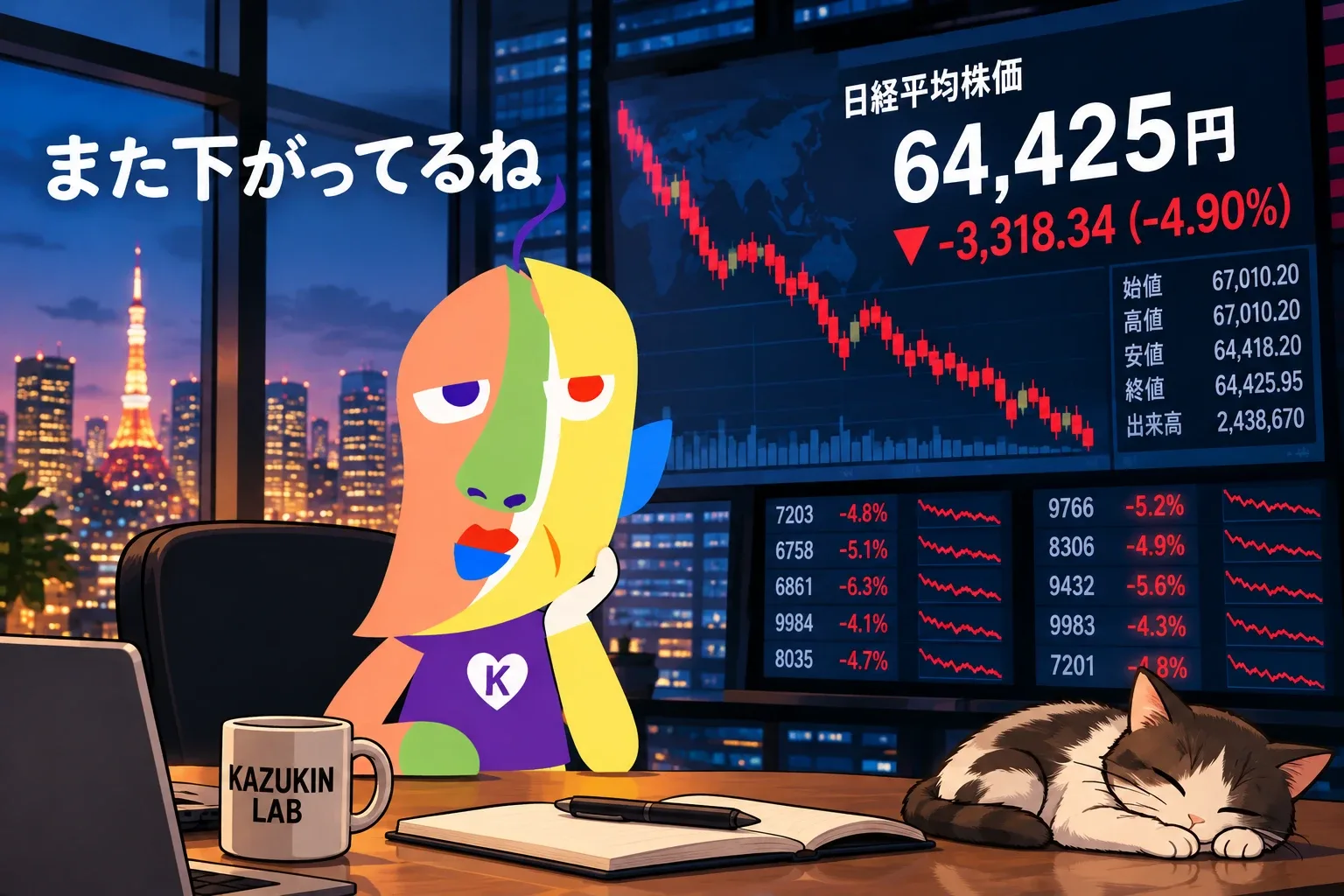
“It's falling again.”
Looking at today's share prices, those words came out naturally.
On October 15, 2026, the Nikkei 225 closed down 3,318.34 yen (−4.90%) from the previous day at 64,425.95.
A sixth straight day of declines. The size of the drop was the third largest in history—quite a violent day.
The Nikkei, which stood at 70,683.98 on October 6, fell more than 6,000 yen in just over a week.
When prices fall this much in so short a time, investors' psychology is badly shaken.
“Will it keep falling?”
“Should I sell while I can?”
And for a contrarian investor, another thought crosses the mind.
“Isn't it about time to buy?”
So, is this drop really a buy?
The hardest part of investing is calling the bottom and the top
If you invest for a long time, you go through the same experience again and again.
You buy a stock thinking it has fallen enough, and it falls further the next day.
Conversely, you sell a stock thinking it is near the top, and it keeps rising afterward.
Looking back, it is easy to say “I should have bought there” or “I should have sold there.”
But judging the right answer in that very moment is extremely hard.
Because the bottom and top of a share price are only known afterward.
For example, say a stock falls from 2,000 yen to 1,500 yen.
It is 25% cheaper, so it looks like a decent buying opportunity.
But the price could fall to 1,200 yen, then 1,000 yen.
Or 1,500 might be the true bottom, with a rebound all the way to 2,500.
Even professional investors find it hard to keep predicting correctly which will happen.
So rather than aiming for the exact bottom, I want to focus on whether I can buy cheaply relative to the company's value.
Why did this crash happen?
This decline came from a combination of credit worries about US AI-related companies, falling semiconductor stocks, and concerns about US monetary policy.
Selling in AI and semiconductor-related stocks in particular pushed the Nikkei down sharply.
One caution, though: just because the Nikkei fell about 5% does not mean the value of every Japanese company dropped 5% in a day.
In fact, TOPIX fell 2.38% on October 15, less than the Nikkei.
In other words, a sharp fall in an index and a change in an individual company's intrinsic value should be considered separately.
Precisely when the whole market is pessimistic, I want to calmly check each company's earnings and finances.
Is a crash an opportunity for a contrarian investor?
I basically prefer contrarian investing: holding undervalued stocks for the long term.
Rather than chasing popular stocks that have risen, I want to find stocks that have been sold for some reason and have become cheap relative to the company's value.
But not every fallen stock is a bargain.
Some have fallen because earnings worsened; others are being sold because of temporary market sentiment.
Telling the difference is important.
The four main indicators I look at when searching for stocks are:
- PBR under 0.7: is the price cheap relative to net assets?
- Equity ratio of 60% or more: is the financial base sound?
- PER of 15 or less: is the price too high relative to profits?
- RSI of 30 or less: has it not been oversold in the short term?
Of course, meeting these conditions does not guarantee a rise.
In particular, a company with a low PBR may already have low profitability or doubts about its future priced in.
That is why I need to check not only the numbers but whether the company can keep generating profit.
Rather than call the bottom, buy in portions
In a sharp decline like this, what I think matters is not putting all my funds in at once.
For example, say I have 1,000,000 yen of spare money to invest.
Even if a stock I like becomes cheap, there is no need to put all 1,000,000 yen in on day one.
Start with 300,000 yen, another 300,000 if it falls further, and use the remaining 400,000 while checking the situation.
This is only an example, but buying in portions eases the psychological burden of having to call the bottom.
Of course, buying in portions still produces losses, and if the decline drags on, unrealized losses grow.
What matters is keeping enough capacity to judge calmly if the price falls further.
I want to invest in a way that does not make me panic even if it falls the day after I buy.
Is this October drop a buy?
This is the hardest part.
Personally, I think this sharp fall creates a chance to reevaluate stocks that had been too expensive to touch.
But I do not intend to declare a full-scale buying opportunity just because the Nikkei fell more than 3,000 yen.
It may well fall further.
There are three points I especially want to check.
- Has the company's performance changed?: Is only the share price falling, or has the company's earning power itself declined?
- Is its financial position sound?: Does it have a financial base that can withstand an economic downturn?
- Is it sufficiently cheaper than my own fair price?: I want to base my decisions on the company's profits and assets, not on market mood.
While checking these three, if there are stocks that meet the conditions, I buy a little at a time.
For now, that is the stance I take toward the market.
When prices fall, an investor's true attitude is tested
When prices are rising, anyone can feel bullish.
If your holdings rise day after day, investing can even feel easy.
But what is truly hard is when prices start to fall.
Unrealized gains shrink and sometimes turn into unrealized losses.
Pessimistic outlooks multiply in the news, and anxious voices spread on social media.
At such times, can you keep calmly looking at a company's value?
I think that is where the difficulty and fun of long-term investing lie.
Of course, if you realize your investment judgment was wrong, cutting the loss is also necessary.
Long-term investing does not mean never selling no matter what.
I think it means constantly checking whether the grounds for believing in the company remain.
Summary: You don't need to call the bottom
The sharp fall of the Nikkei in October 2026.
Whether this is a temporary correction or the start of a real bear market, I cannot answer at this point.
But there is one thing I can say.
What matters in stock investing is not buying at the bottom and selling at the top, but buying at a price you are satisfied with and selling for a reason you are satisfied with.
Share prices may fall further tomorrow.
They may have rebounded strongly by next week.
Either way, I want to be ready to respond without panic.
Watching today's market, I thought about these things once again.
“It's falling again.”
But it's not all bad.
Maybe the fun of searching for undervalued companies has just grown by one more.

分けて買えば、慌てないよね・・
KAZUKIN Rating
- 📉 Composure while watching a crash — ★★★★☆
- 🎯 Confidence in calling the bottom — ★☆☆☆☆ (never once right)
- 🧮 Mastery of buying in portions — ★★★★★
- 🔍 Excitement of hunting for undervalued stocks — ★★★★★
- 😴 Cat-like calm — ★★☆☆☆ (I can't beat the cat)
This article is KAZUKIN's personal opinion and record. Share prices, indices, earnings and holdings mentioned here are as of the posting date and may have changed since. It is not a recommendation to buy or sell any particular financial product or stock, and it does not guarantee future profits. Please make your own investment decisions at your own responsibility.
References: Nikkei Inc. “Nikkei Stock Average Profile” (October 15, 2026); same-day market reports by Jiji Press and Kabutan.
The illustration is an image based on KAZUKIN's imagination. The prices and figures shown match the article's content and are not an actual trading screen.